How to Create a Website Step by Step: A Beginner's Guide
Contents
How to Create a Website Step by Step: A Beginner’s Guide
Creating your first website can feel like a much bigger project than it actually is.
You may be wondering where to start, whether you need to know how to code, what pages your website needs, how to connect a domain, or how to make a website for business when you’ve never built one before.
The good news is that you don’t have to figure everything out at once.
If you break the process into a few clear steps, you can go from an idea to a live website without writing code or hiring a developer.
TL; DR
- You don’t need coding skills to create a website. A no-code website builder can handle all the technical side for you.
- Start with a clear goal and structure. Decide what your website should achieve, which pages you need, and what visitors should do on each page.
- Use templates and pre-built blocks to save time. Customize an existing design instead of building everything from scratch.
- Focus on clear content and simple design. Make your message easy to understand, keep your design consistent and browsing mobile-friendly.
- Test your website before publishing. Check your content, links, forms, buttons, mobile experience, and basic SEO settings.
- Launching is only the beginning. Update your content, add new pages, and improve your website as your project grows.
1. Decide what your website is for
Before you open an editor, answer one simple question:
What should your website help you achieve?
Your answer determines almost everything that comes next — which pages you need, what information to include, what calls to action to use, and even which type of website you should build.
For example, your goal might be to:
- Get more inquiries from potential customers
- Sell products online
- Show your portfolio
- Promote a service
- Collect bookings
- Build an audience
- Provide information about your organization
- Create a personal website.
For a small service business, for example, the goal might simply be: help potential customers understand what I offer and contact me.
That immediately gives you a starting point for deciding what the website needs and how to create a website for small business without overcomplicating it.
How many pages do you need?
Your first website doesn’t need 20 pages.
A small business website might start with:
- Home
- Services or Products
- About
- Reviews or Testimonials
- Contact.
A portfolio might need just Home, Portfolio, About, and Contact.
A landing page is a single page focused on a specific offer.
The goal isn’t to build everything you might ever need.
Create a website for small business with Weblium – add the pages for your main goal in one day. Later on, you can always add more or additionally customize everything to fit your needs.
2. Choose how you want to build your website
Once you know what you need, choose how you’ll build it.
There are several ways to build a website:
- Hire a web designer or agency
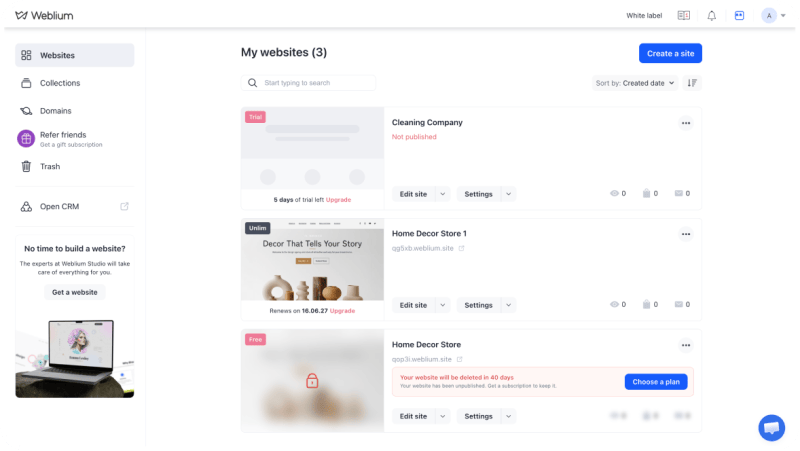
- Build it yourself with a drag and drop website builder
- Use AI to generate parts of the website
- Combine professional help with a website builder.
For most beginners, a simple website builder is the best way to get started.
What is a website builder and how does it work? An easy website builder should give you a drag-and drop visual editor where you can create pages, add sections, change text and images, and adjust the design without any tech setup.
Instead of developing every element from scratch, you work with pre-built blocks and customize them for your project.
This is especially useful if you’ve never created a website before. You can focus on your content and business instead of delving into technical details.
Is It Possible to create site without coding?
Yes.
If you’re using a no code website builder, you can create the website through a visual editor. You don’t need tech experience to add pages, rearrange sections, edit text, upload images, or create buttons and forms.
That doesn’t mean you have to give up control. You can still decide how the website looks and how it works.
3. Plan your website structure
Now that you’ve chosen your approach, decide what your website will contain.
Think of your website as a collection of pages, and each page has its own collection of sections or blocks.
For example:
Home
Hero → Benefits → Services → Reviews → About → CTA → Contact
Services / Products
Introduction → Your Offers → Pricing → FAQ → CTA
About
Story → Team → Values → Experience → CTA
You don’t need to design every detail on paper first. A simple outline is enough.
What Should Go on Your Homepage?
Your homepage usually needs to answer four questions quickly:
- What do you offer?
- Who is it for?
- Why should someone choose you?
- What should they do next?
A typical homepage should include:Hero section with your main message and CTA
- Short explanation of your offer
- Key benefits or services
- Social proof such as reviews or client logos
- About or credibility section
- FAQ
- Final call to action.
Don’t worry about making every section perfect at this stage. You’re creating a structure that you can fill with content later.
4. Choose a website template
You don’t have to design every page from a blank canvas.
One of the easiest ways to get started is to choose a template that already has a structure close to what you need.
Browse website templates based on your industry, website type, and visual style.
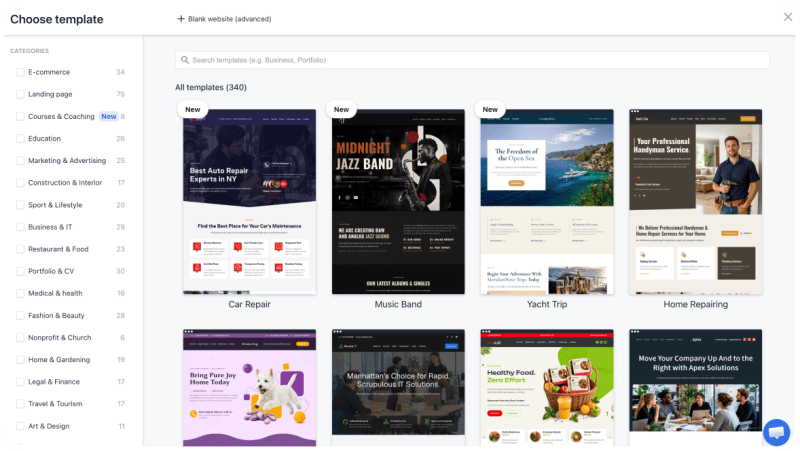
A template can give you:
- A starting page structure
- Pre-designed sections
- A consistent visual style
- Example layouts
- A starting point for your content.
How Do You Choose the Right Template?
Don’t choose a template only because you like its colors or photos. Look at its structure.
Ask:
- Does it have the types of pages I need?
- Does the homepage put the main offer front and center?
- Is there enough space for my content?
- Does the layout fit my type of business?
- Can I easily replace the example content with my own?
You don’t need a template that matches your business perfectly. You need one that gives you a useful starting point.
Once you’ve chosen one, you can change the content, images, colors, fonts, and sections to make it your own.
5. Build your pages with blocks
Now it’s time to start building.
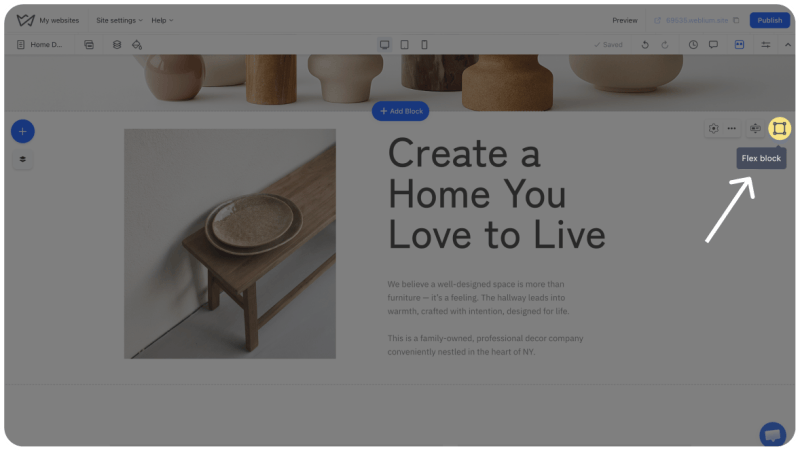
A drag and drop website builder typically uses blocks or sections as the basic building pieces of a page.
Instead of designing a webpage element by element, you can add and customize a block for:
- A hero
- Text and images
- Services
- Pricing
- Testimonials
- FAQ
- Contact information
- Forms
- Calls to action.
Think of it like assembling a page from ready-made pieces.
Start with the most important page (usually your homepage) and build from the top down.
Don’t try to build everything at once
A common beginner mistake is trying to finish the entire website before publishing anything.
You don’t need to.
Build the essential pages first. Get the structure right. Add the most important content. Then improve the details.
Your first version doesn’t have to be your final version.
You can publish a solid 5-page website and add a blog, additional services, or other sections later.
Your website can grow with your business! When you launch a new service, promotion, or campaign, create a dedicated landing page instead of changing your main site.
Read a step-by-step guide and learn how to create a landing page with ease.
Add the features your business actually needs
It may be tempting to add many features at once. Don’t. Start with 2-3 features that support your customers, build trust, and generally make things easier.
| Contact & lead forms | Collect quote requests, consultation requests, newsletter signups, or general inquiries. Send submissions to your email or connect them to a CRM. |
| Booking & appointments | Let clients schedule consultations, classes, salon appointments, or service calls directly from your site. |
| eCommerce & payments | Sell products, accept online payments, take deposits, or offer gift cards without building a checkout from scratch. |
| Quizzes & calculators | Help visitors choose a service, estimate a price, or provide information before they contact you. For example, a remodeling company could use a project-estimate calculator. |
| Testimonials & reviews | Add customer feedback, ratings, or case studies to build trust before someone books or buys. |
| Portfolio & galleries | Showcase photography, design work, renovations, events, products, or completed projects. |
| Maps & location blocks | Make it easy for customers to find a restaurant, salon, clinic, studio, or local store. |
| FAQ sections | Answer common questions about pricing, delivery, availability, services, or policies. |
| Social media and video | Embed Instagram feeds, YouTube videos, or other content when it genuinely helps visitors understand your business. |
| Marketing integrations | Connect tools, email marketing platforms, or your CRM to track and follow up with leads. |
| Custom code and integrations | Add third-party tools when your business needs functionality beyond the built-in features. |
6. How to make website look professional
You don’t need to be a professional designer to create a polished website.
Consistency does most of the work.
Choose a small set of:
- Fonts
- Colors
- Button styles
- Image styles
- Spacing rules.
Then use them consistently throughout the site.
Start with the basics:
- Keep the layout clean. Don’t fill every available space.
- Make the main message obvious. Visitors shouldn’t have to search for what you offer.
- Use readable text. Avoid tiny fonts and long walls of copy.
- Use high-quality images. Blurry or irrelevant images can make an otherwise good website look unfinished.
- Make buttons clear. Tell visitors exactly what will happen when they click. Use “Book a consultation,” “View pricing,” or “Get a quote”.
- Check mobile layouts. Your website should work well on phones / tablets as well as desktops.
You don’t need dozens of visual effects to make a website look professional. A clear hierarchy, good spacing, consistent design, and useful content are usually more important.
7. Use AI to build a website if it helps you get started
If the hardest part is figuring out what to write or how to structure a page, AI can help you get past the blank page.
You can use AI to:
- Generate a first draft of website copy
- Suggest page sections
- Brainstorm headlines
- Create ideas for calls to action
- Help organize information
- Generate parts of a page from a description.
Weblium has a built-in toolkit if you want to create a website with AI. Use it to get a nice foundation and start building your website with confidence.
8. Check how long it will take
Here’s a practical estimate for the most common scenarios:
| Website type | Freelancer / agency | Website builder |
| Landing page | Several days-2 weeks | A few hours-1 day |
| Simple website (3-5 pages) | 1-3 weeks | A few hours-1 day |
| SMB website (5-10 pages) | 3-6 weeks | 1-2 days |
| Small online store | 4-8 weeks | 2-3 days |
| Advanced custom website | 2-6+ months | Several weeks+ |
Can you really build a website in a day?
Yes – if you choose the right type of website.
A one-page landing page, portfolio, or simple 5-page site for business can realistically become a same-day project.
| Task | Approx. time |
| Choose a template and outline the page | 20-30 min |
| Adapt the structure to your offer | 30-45 min |
| Add and edit copy | 60-90 min |
| Add images and branding | 30-45 min |
| Adjust layout | 20-30 min |
| Add contact/CTA elements | 15-30 min |
| Proofread and test | 30-45 min |
| Total | ~4-6 hours |
Want a practical breakdown by weblium?
Read a guide for a closer look at practical steps to create a website, what can slow you down, and how to get your website live faster.
How long does it take to build a website?
9. Get Your Domain Name
Your domain is your website’s address on the internet, such as yourbusiness.com.
If you haven’t bought one yet, choose a domain that’s:
- Easy to remember
- Easy to spell
- Relevant to your business or project
- Short enough to type comfortably.
If possible, use your business name or a clear variation of it.
Start with your domain and hosting
With Weblium, hosting is included, and you can get a free domain for the first year with any paid plan (starting from just $11 per month).
What if you already bought a domain?
Buying a domain doesn’t automatically create a website.
The domain is simply the address. You still need to build the website and connect that address to it.
If you’ve already bought your domain, you can easily connect it to your website builder.
For the detailed step-by-step instructions, see how to make a website after buying a domain on Weblium.
10. Review your website before publishing
Now take a final tour as if you’re a visitor seeing it for the first time.
Check:
Content
- Are there spelling or grammar mistakes?
- Are all prices and contact details correct?
- Are the headlines clear?
- Have you removed all template content?
Not sure what website content you need?
It’s easy to overlook an important section or miss some information when you’re building your first website. Use our website content checklist to make sure you’ve covered everything before publishing.
Links and Buttons
- Do all buttons work?
- Do navigation links lead to the right pages?
- Does the logo link back to the homepage?
- Do external links open correctly?
Forms
- Can visitors submit your contact form?
- Do you receive submissions?
- Is the confirmation message clear?
Mobile
- Text size
- Image cropping
- Button placement
- Navigation
- Spacing
- Horizontal scrolling.
SEO Basics
- A descriptive page title
- A useful meta description
- A clear main heading
- A logical URL
- Relevant content.
You don’t need to become an SEO expert before launching your first website. Get the fundamentals right and improve them over time – or ask the Evo AI assistant to generate some variants of metadata / SEO settings and automatically fill them for you.
11. Publish your website
It’s time to check how to make website live.
Using Weblium, you can do this directly from the editor: review your site settings, connect or select your domain, and publish your website. Your site is then accessible to visitors through its web address.
Open the published site and test it as a visitor once again:
- Visit your main pages
- Click every important button and link
- Submit your contact forms
- Check the site on your phone
- Make sure your domain opens the correct version of the site.
This final check can catch issues you may not notice during the previous step. Here is how to make website live in just a few minutes.
What happens after you publish?
Going live is the start of your website. As people start visiting your site, use what you learn to improve it.
For example, you might notice that a service needs a clearer explanation, a CTA needs to stand out more, or customers keep asking a question that belongs in your FAQ. Return to the editor, make those changes, and publish the updated version anytime you want.
Start with a solid first version, then improve your website as your business and visitors give you more information about what works.
What if my website doesn’t appear on Google?
Don’t panic if your newly published website doesn’t immediately appear in Google search results.
Search engines need time to discover and index new pages, and appearing in search results isn’t automatic.
If your site has been live for a while and you’re concerned, check the common reasons in our guide.
Why doesn’t my website show up on Google?
Cost to make a small business website
For many small businesses, a drag and drop website builder is the most affordable way to get a professional site without paying thousands upfront. You can build the site yourself using templates and highly customizable blocks, then choose a plan based on the features you need.
| Option | Upfront cost | Ongoing cost | Best for |
| DIY website builder | ~$0-30 | ~$11-30 per month | Straightforward small business sites |
| DIY with WordPress | ~$100-$300 | ~$10-$50 per month | Businesses that want more flexibility and control |
| Freelancer | ~$2,000-$8,000 | Variable | Custom design or additional functionality |
| Agency | ~$10,000+ | Variable | Businesses that want a done-for-you website |
For current plans and pricing, check out the cost to make website on Weblium.
Can you create a website for free?
You can use a free website builder, but they usually come with limitations such as a platform-branded domain, restricted features, storage, or no eCommerce functionality.
With Weblium, you can try the full set of features for 14 days. This gives you time to build your pages, test the editor, connect the features you need, and see whether Weblium is the right fit for your website before choosing a paid plan.
How to create a website from scratch
For a beginner, it can simply mean starting with an idea and building the website yourself. The process looks like this:
- Set the goal: Know what the website needs to accomplish.
- Plan the pages: Decide what information visitors need.
- Choose your platform: Use the best DIY website builder for your skills and needs. Compare platforms and their features.
- Choose a template: Start with a structure instead of a blank page.
- Build the pages: Add and customize blocks.
- Add your content: Replace placeholder text and images with your own.
- Polish the design: Adjust fonts, colors, spacing, images, and mobile layouts.
- Connect your domain: Point your domain to the website.
- Test everything: Check content, navigation, forms, and mobile layouts.
- Publish: Make the website accessible to visitors.
That’s how to start a website from scratch without making the process unnecessarily complicated.
Ready to create your first website?
You don’t need to know everything before you begin.
Start with the goal. Plan the pages. Choose a template. Build the sections. Add your content. Connect your domain. Test the site. And publish it.
Then improve it as you go.
The easiest website builder handles all the technical groundwork so you can focus on your business, content, and customers.
If you’re ready to try building your first website yourself, start with Weblium and work through the steps to create a website.
FAQ
How to build a website?
The basic steps to build a website are: define its goal, choose how you want to build it, plan your pages, choose a template, build your pages with blocks, add your content, polish the design, connect your domain, test everything, and publish. When choosing the best beginner website builder, look for an intuitive editor and useful templates, first and foremost.
How to Make a Website for Free?
Some DIY website builders let you start without paying, but free plans often come with limitations such as a branded domain, fewer features, or restricted storage. Here’s how to create a website for free: use a website builder’s trial period to build and test your site before committing to a paid plan.
How do I make a website live after buying a domain?
Buying a domain only gives you the web address. To make a website live after buying a domain, you need to build the site, connect your domain to your website builder, check your settings, and publish the site. In Weblium, you can connect an existing domain from your site settings and then publish your website.
What is the easiest website builder for beginners?
The easiest website builder for beginners is usually one that doesn’t require coding, hosting setup, or technical configuration. Look for a visual editor, ready-made templates, and pre-built blocks that you can customize. A simple website builder like Weblium lets you build pages visually instead of creating them from code.
How much does it cost to build a website?
It depends on how you build it and how much work you outsource. A drag and drop website builder is generally much less expensive than hiring a freelancer or agency, while custom websites can cost thousands of dollars. Your costs may also include a domain, hosting, premium features, and third-party services. Check out Weblium’s current pricing for plan details.
How do I make a website look professional?
Good beginner website design doesn’t require complicated effects. Use a limited set of fonts and colors, keep spacing consistent, use high-quality images, write clear button labels, make your main message obvious, and check how every page looks on mobile devices. A clean layout and useful content usually matter more than complex design.
How to create a website from scratch for my small business?
Start with 5 core pages: Home, Services or Products, About, Reviews or Testimonials, and Contact. You don’t need to create every possible page before launching. Add the information customers need to understand your business and take the next step, then add pages as your business grows.
Do I need a domain before I build my website?
No. You can build a website first and connect your domain later. This is often easier for beginners because you can work on the design and content without worrying about domain settings. Once your website is ready, connect your domain and publish it.
Can I create a website without complex tech setup?
Yes. A no code website builder lets you create pages, add sections, edit content, and customize the design without programming. You may still encounter technical concepts such as domains or SEO settings, but you don’t need any specialized skills to handle the process.
What should I do after my website is published?
After you make your website live, test it once more from a visitor’s perspective. Check your forms, links, mobile layout, contact information, and important calls to action. Then give search engines time to discover your pages and monitor how visitors use the site. You can update your content, add new pages, or improve sections as you learn what your visitors need.